Last Minute Campaign Finance Rule Change
Ruling Party Ol' Switcheroo?
Ruling party’s big-money political machine grinds on.
State law could be scrutinized under 1st Amendment.
Democrats are exploiting old rules to compel a third-party to institute a censorship program. The ruling party, and the constellation of groups supporting them, benefit from current campaign finance rules — while grassroots and outsider campaigns are locked out of inexpensive online advertising.
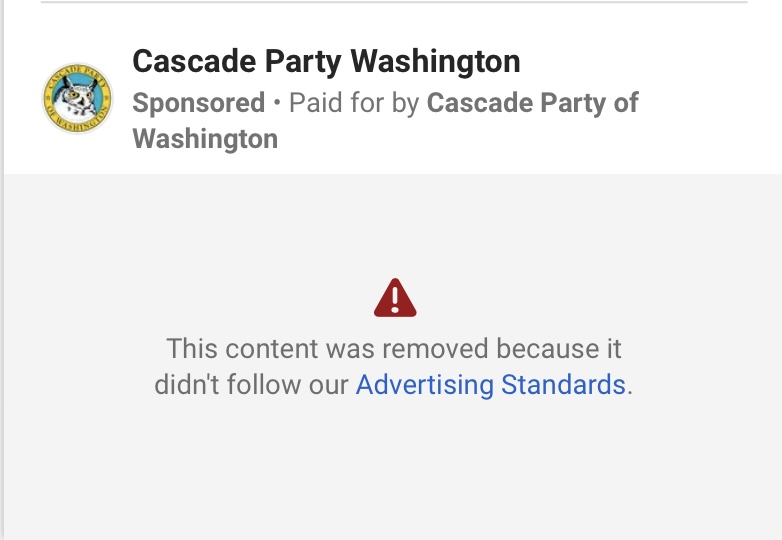
Cascade Party ads for our blog THE SUMMIT were rejected by Facebook during the 2026 general election. These were not campaign ads — Facebook rejected opinion articles never mentioning words like “elect”, “vote for” or “support”.
We published an article written by Marcia Kelbon, a Cascade Party member who was running for state house as an independent. Her article never mentioned she was a candidate for public office. Nevertheless, this advertisement was rejected by the Facebook algorithm. Apparently, Cascade’s advertisement was disqualified because Kelbon happened to be on the public ballot.
Cascade Party is an approved advertiser on Facebook / Meta. Earlier this year, we were vetted by the company before they allowed us to run ads on their private platform.
Meta discloses who sponsored an ad. In addition, Meta’s Ad Library produces every advertisement Cascade Party has ran on the platform. This disclosure provides the public with the estimated audience size, amount spent and impressions, among other information.
Cascade Party supports public disclosure in campaign spending, as it helps to inform the reader about who is doing the speaking. It’s good Washington has stood by this principle for decades.
Old Rules / New Restrictions
The Washington Public Disclosure Act was a 1972 ballot initiative approved by 72 percent of voters. Initiative 276 is state level good-government campaign finance reform.
Washington requires strict reporting of campaign contributions, campaign spending, lobbyist activities and the personal financial affairs of elected officials and candidates. I-276 also created the Washington State Public Disclosure Commission (PDC) to enforce these rules and provide public access to campaign finance records.
This is in the public interest, however, some rules are not keeping up with the times.
I-276 established the core rule requiring all "commercial advertisers" to maintain public inspection records of anyone who buys political ads, including buyer names, addresses and payment details. In 1972, this meant newspapers, radio and television stations.
In 2018, the legislature closed a major digital loophole by clarifying that Washington’s campaign finance transparency laws apply directly to online platforms selling political ads — requiring disclosure of targeted demographics and ad impressions within two business days of any public request. If a platform fails to fully comply, it can be fined $30,000 per violation.
Facebook (now Meta) was contacted to provide the legally required data. Meta claims only three people have ever made this request[1]. One request was from The Stranger. This is media which not only reliably endorses ruling party candidates — online platforms are their competitor.
Regarding The Stranger's request, Meta "did not obtain, maintain, or provide any of the legally required information", triggering a legal action by our state. This eventually resulted in a $35M penalty — the largest campaign finance law fine in US history.
Considering the potential for more massive fines, and the complexity of our state rules, Meta, Google, Yahoo and others no longer allow political ads for Washington state elections.
This is a shame as digital advertisements are among the least expensive forms of political advertisement.
De facto Censorship
Public employee unions can afford expensive traditional media — they flip millions of dollars accumulated from every state employee’s paycheck deduction into political campaigns. In fact, these powerful groups are the largest spender in our elections.
The ruling party’s big-money political machine grinds on, while grassroots and outsider campaigns are locked out of the inexpensive advertising Facebook, Google and other platforms can provide.
As cited above, advertising for non-campaign issue speech is also suppressed.
Ruling Democrats are exploiting old rules to compel a third-party to maintain a censorship program. Meta has turned to the Supreme Court of the United States for relief, filing a petition claiming 1st Amendment violations by our state. Washington’s response is due on December 18, 2026, after which the High Court will decide whether to take up the case.
Free speech in the United States is held to strict scrutiny legal standards. If the case proceeds, our state will have to explain how the rules are in the public interest.
Public disclosure of who is spending in elections is good government policy. However, our state’s laws are a barrier to speech. We must maintain campaign disclosure while at the same time protect freedom of expression.
[1] META PLATFORMS, INC. v. STATE OF WASHINGTON, November 13, 2026 (app. 103)