UnSeattle: Détente Among Polarized Addiction & Homelessness Remedies.
Rivals Debate Solutions.
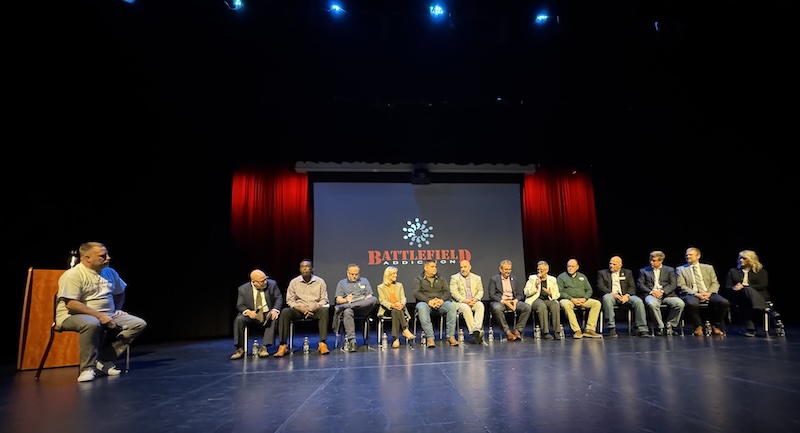
Report on October 8, Battlefield Addiction Event.
By Marian Hanson, October 27, 2026
A report on the October 2026 community gathering in South King County organized by the nonprofit Battlefield Addiction to address the region's overdose crisis. The event brought together local mayors and community members to critique current Washington state rulings and policies such as the Blake decision, "Housing First," and "Harm Reduction" initiatives.
Battlefield Addiction is a nonprofit based in Kent. Their stated mission is helping families navigate addiction to guide their loved ones into full recovery. The group receives no public money.
On October 8, 2026, Battlefield Addiction held an event at the Kent-Meridian High School Performing Arts Center called, Hey Bob, We Need Your Help! This was organized, “out of desperation”, according to Battlefield Addiction’s founder, Art Dahlen, to send a message to Governor Bob Ferguson.
Opioids accounted for nearly one-in-five of all-cause deaths in King County among adults 18-64 years old in 2024 (King County Mortality: Trends and Disparities 2015-2024, p.31). During 2021-2025 there were a total of 5,128 confirmed overdose deaths in King County. In 2025, 78% of fatal overdoses in King County occurred in the following five cities: Seattle 55.7%, Kent 6.4%, Renton 6.1%, Auburn 5.2%, and Federal Way 5.1% (King County Washington Overdose Fatality Review 2025 Report, p.5).
This matters because, as Dahlen pointed out, there were no elected officials from Seattle present at this event — even though they were invited.
Robert Boenish, Ph.D. was there representing Gov. Ferguson’s office. Thirteen mayors from South King County, North Pierce County and Lynnwood attended, along with other elected officials. Also present were concerned community members, many who have lost family or friends to drug overdoses.
Policies Have Consequences
Since 2020, Olympia has pivoted toward social justice initiatives that prioritize public spending on social programs over law enforcement. Our state’s highest court echoed this ideological shift when it decriminalized drug possession in the 2022 Blake decision.
Facing growing political pressure over public drug use and homelessness, lawmakers passed Senate Bill 5536 — the "Blake Fix", during a special one-day legislative session in May of 2023. Democratic Party aligned interest groups had pushed for retaining decriminalization, claiming drug laws were, “profoundly racist.” Before Blake, possession was a Class C felony. Activists leading our state’s ruling Democratic party made possession a lesser charge of “gross misdemeanor” with the Blake Fix.
The Chronic Addiction Homelessness crisis has grown since 2020’s pivot from law enforcement. As a result, an average of 15 people die every week from drug overdose in King County alone.
Current public policy supports programs like “Housing First” and ‘Harm Reduction”. These approaches allow addicts to use drugs with the hope that —when the addict is ready— the individual eventually gets sober, leading to turning their life around. With the human toll of 2+ drug overdose deaths in King County every day, current public policy is deadly and incredibly expensive. The status quo has also produced spectacular administrative failures like the King County Regional Homelessness Authority.
Opposition Voices
The voices at the Battlefield Addiction recognize the failing status quo and call for a return to accountability for the individual.
“While we argue about taking care of people, they aren’t being helped,” says Dahlen. “We need to hold drug users accountable, but this does not mean punishment. It means requiring more from them.”
So Dahlen asked the mayors this question: “Tell us what makes it difficult to fight drugs in your city?”
Here are a few highlights:
Kent Mayor Dana Ralph answered, “Addiction is a disease, but it’s not okay to have no consequences. When they changed drug possession from a felony to a misdemeanor, it took the teeth out of the consequences. Now the government facilitates the addictions and this is killing people!”
Pacific Mayor Vic Kave, who is also a firefighter said, “There is no ‘functional’ fentanyl user. It may start out just (affecting) them, but then extends into the community and starts to destroy their lives also. We need incarceration with treatment for some time, then maybe provide job training later.”
“It is frustrating to have legislators come take notes, nodding their heads and agreeing, and then say they can’t do anything,” says Enumclaw Mayor Anthony Wright, adding, “We need to vote them out of office.”
Kristine Moreland, Executive Director of The More We Love, says she has “seven babies in her care right now on tubes due to fentanyl exposure.”
State Rep. Jim Walsh from SW Washington, who is also state GOP Chair, asked mayors which is the most damaging; the Blake Decision, Housing First” or Harm Reduction? There were many answers among the attendees, mostly indicating, “all three”, including other causes; such as softly defunding King County prosecutors. One panelist said, “If the government does it, it is called ‘harm reduction’. But really, it is just enabling.”
Normandy Park Mayor Eric Zimmerman stated, “In 2014 the federal government made it easy for money to flow into Housing First. Washington State’s homelessness grew 418% during 2014-2024. Seattle and King County are number one in homelessness growth at 850%. Something went very wrong with our bet on ‘Housing First’. For years we’ve been number one for overdoses that show up in hospitals. This needs to be investigated. Our government leaders say we did it right, and show statistics, but the data shows it’s wrong. We need accountability. The governor is a good man, but you can become committed to a fable, and you stop checking to see if it is true.
Here’s the message from this community of recovery / service groups and elected leaders, “Hey Bob! We need your help!”
Marion Hanson lives Shoreline.
Rivals Debate Solutions.
Researcher critical of arrest diversion program data.
We need to change course to save lives and reclaim our public spaces.
Too many drug overdose deaths.