Cascade Party
A new path in Washington State politics.
A new path in Washington State politics.
Portland's gravitational pull.
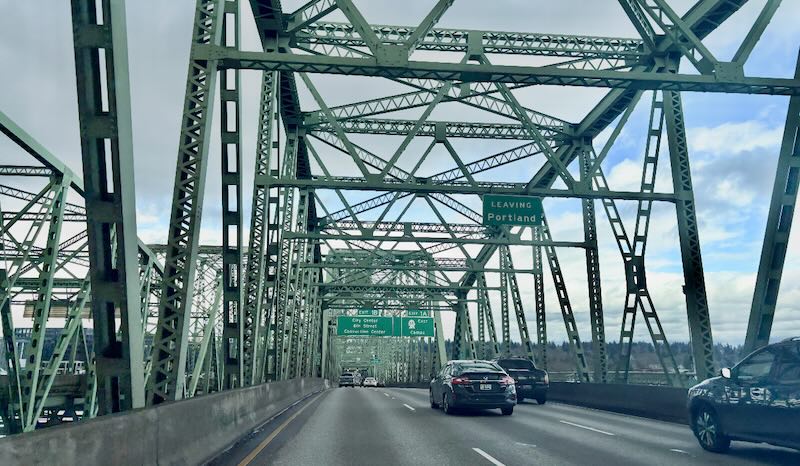
Will Max Light Rail Over The New Interstate Replacement Bridge Help Vancouver Grow or Will It Simply Make Portland Feel Closer?
By Johann Peters (March 25, 2026)
THE PROMISE OF CONNECTION
There is a quiet tension building along the Columbia River, where the proposed Interstate Bridge replacement and the extension of MAX light rail into Vancouver, Washington promise connection but also raise questions about who truly benefits.
On paper, the idea feels elegant. A seamless line carrying people from Vancouver into Portland, Oregon, gliding into the energy of the Moda Center and Veterans Memorial Coliseum in the Rose Quarter, home to the Portland Trail Blazers and Portland Winterhawks. Nearby, the Oregon Convention Center draws large events and steady crowds. It feels like access and convenience. Yet underneath is a quieter question about direction, and which way people will flow.
A CITY STILL FINDING ITS CENTER
Vancouver is growing, but it does not mirror Portland’s concentration of major attractions. It has no major league sports teams and only a few large venues such as the Clark County Amphitheater, the fairgrounds and the ilani Casino Resort further north. Its downtown has been reshaped by a roughly $1.5 billion waterfront investment that has created a walkable and appealing riverfront. Restaurants and public spaces are beginning to define a local identity that stands on its own.
THE QUIET PULL SOUTH
Light rail changes the equation. It makes it easy to step onto a train and arrive in Portland’s cultural core, including venues managed by Portland’5 Centers for the Arts such as the Arlene Schnitzer Concert Hall and Keller Auditorium, along with theaters inside Antoinette Hatfield Hall including the Newmark Theatre, Dolores Winningstad Theatre, and Brunish Theatre. These venues host more than 1,000 performances each year, adding to a steady calendar of concerts and events, with further expansion planned through a new 5,000 seat Live Nation venue. For residents, this feels like expanded access. For Vancouver’s downtown, it may act as a steady pull outward.
THE FOOTPRINT ON THE GROUND
The infrastructure itself brings local consequences. Light rail requires stations, access points, and often expanded parking. In Vancouver, corridors like Evergreen Boulevard could absorb that pressure, shifting land toward transit support uses. Eminent domain becomes a practical concern when familiar streets are reshaped to accommodate regional mobility.
AN UNEVEN CONNECTION
The bridge is meant to connect two cities, but connection is rarely balanced. Portland holds a dense cluster of jobs, entertainment, and cultural destinations. Vancouver is still building that gravity. When movement becomes easier in one direction, the pull often follows the stronger center. Vancouver’s investment in its waterfront suggests a desire to build something lasting, yet a system that simplifies leaving may work against that effort.
A QUESTION THAT LINGERS
Should Vancouver, Washington make it easier for TriMet and MAX light rail to draw activity across the river into Portland, Oregon? Light rail offers clear benefits in mobility and sustainability. Still, the question remains whether it will help Vancouver grow into itself, or simply make Portland feel closer while Vancouver becomes a place people pass through on their way somewhere else.
Johann Peters is on the Cascade board of directors serving in one of the postions for district 3/6.