
Cascade Party
A new path in Washington State politics.
A new path in Washington State politics.
Five-Mile Mega-Project — Decade+ boondoggle.
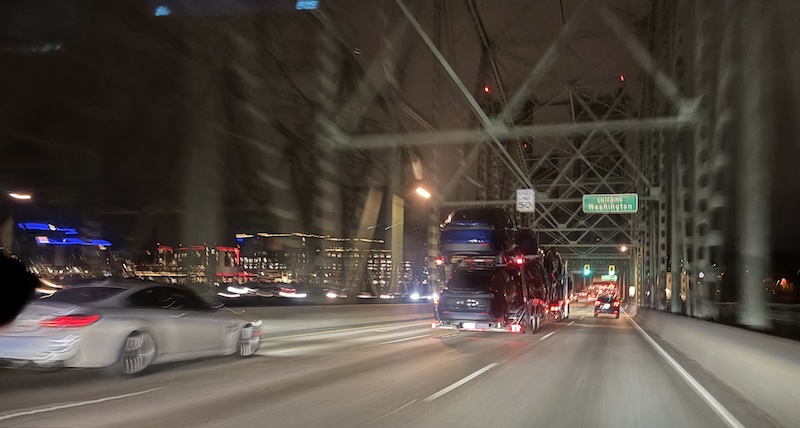
Vancouver's I-5 Interstate Bridge Replacement is a five-mile mega-project which happens to cross the Columbia river at the south shore of the city. It's been a money pit, feeding design consultants for years — to the tune of over $400 million. It's time to get out and build crossings that meet the needs of the 21st Century.
By Johann Peters. (January 28, 2026)
The Columbia River Crossing (CRC) project was officially suspended in 2014 after the Washington State legislature declined to provide additional funding following more than $200 million already spent. Oregon soon followed with a formal shutdown.
In 2019, the concept was revived under a new name: the Interstate Bridge Replacement (IBR). Since then, planning alone for this successor project has again exceeded $200 million.
The IBR is not only a bridge replacement, it is a five-mile interstate mega-project, extending roughly 2.5 miles north and 2.5 miles south of the Columbia River, absorbing interchanges, ramps, and surface streets far beyond the bridge itself.
Just as the CRC was folded, the mega-project IBR must also be stopped before it's too late to turn back.
The alternative is to simply build a new bridge, spanning the Columbia, to replace the existing aged trestles.
It's been said, "the 3rd time's a charm" and a new bridge should accommodate autos, trucks, buses and any new technology. In other words, the new bridge should not have transit rail.
FROM BRIDGE TO MEGA-PROJECT
When the IBR was reintroduced, it was described as a $3B to $4B bridge replacement. In practice, it quickly expanded into a sweeping reconstruction of I-5 from Hazel Dell to Marine Drive.
Within a few years, cost estimates rose to $6B to $7.5B. More recently, reporting reveals that total costs have soared to $12.2B–$17.7B.
This escalation has occurred before construction, before competitive bidding, and before final design. Momentum has replaced accountability.
THE UNANSWERED COST QUESTION
If estimates can balloon so dramatically during planning, what confidence should taxpayers have in the numbers still to come?
Equally troubling is the growing likelihood that meaningful competitive bidding may never occur. The IBR relies heavily on progressive design-build and pre-selected delivery models that limit open competition. While often described as efficient, these approaches reduce price discovery, weaken cost discipline and insulate mega-projects from market pressures that typically protect the public.
When hundreds of millions are spent before construction begins and final costs remain speculative, the lack of robust competition should concern anyone paying attention.
THE REAL PROBLEM IS SCOPE
The core flaw in the IBR is not simply that it is expensive. The mega-project attempts to solve too many problems at once by rebuilding five miles of interstate around a single river crossing.
The region does not need a five-mile mega-project to address seismic risk at the Columbia River. It needs a safe, resilient crossing, not wholesale reconstruction of surrounding highway corridors.
A more rational approach would separate the bridge from a corridor rebuild.
A new crossing could be delivered while leaving the 2.5 miles north and south of the river largely intact, avoiding massive interchange expansions that drive cost, complexity and delay.
WHAT A $12 BILLION BUDGET COULD FIX
If Washington and Oregon are truly prepared to contemplate a $12B to $17B transportation investment, the conversation should extend beyond a single corridor.
A system-level framework would allow multiple high-priority safety and reliability needs to be addressed, spread risk across the network, and deliver visible results sooner. Projects could be sequenced, competitively bid, and delivered incrementally instead of hinging the region’s future on one mega-project.
This framework should include a new Columbia River crossing east of I-205, providing redundancy, freight resilience, and emergency flexibility without forcing all regional mobility through a single choke point.
Within the same regional transportation network, several major bridges already face documented structural, seismic or functional deficiencies.
The Lewis and Clark Bridge between Longview, WA and Rainier, OR is another river crossing in need of improvement. The two-lane bridge, built in 1929, is no longer adequate for modern traffic loads, which exceed 20,000 vehicles daily.
Replacement of the Hood River–White Salmon Bridge has also been studied extensively, with planning estimates at $1.2B.
Even using generous assumptions, these needs together fall well below the $12B to $17B cost estimate widely reported for the IBR alone.
THIS IS THE MOMENT TO PAUSE
Proponents of the current IBR argue that delaying a full Interstate Bridge Replacement only increases costs; and that inflation and seismic risk are real.
This frame intends to create pressure to drive the very expensive and disruptive mega-project forward. It's pitiless towards taxpayers, including locals who will have to live with many years of construction detours. There is a difference between blind momentum and strategic pause. I propose we pause to reassess scope and assumptions which accelerate a project whose foundational logic no longer holds.
Johann Peters is on the Cascade board of directors serving in one of the postions for district 3/6.