Cascade Party
A new path in Washington State politics.
A new path in Washington State politics.
Voting & Elections
An overview of the Electronic Registration Information Center.
By Damon Townsend (December 30, 2025)
Debates over election integrity often focus on outcomes rather than infrastructure. We need clean voter rolls, accurate registrations, and safeguards against double voting. However, far less attention is paid to how states are supposed to achieve those goals within the legal and technical limits of the U.S. election system.
The Electronic Registration Information Center, commonly known as ERIC, was created to address a specific and well-documented problem. The United States does not have a national voter registration database, does not maintain a single authoritative citizenship registry for election purposes and does not operate a federal system that checks whether voters are registered or voting in multiple states
Elections are administered by states, as the Constitution intends. Each state maintains its own voter registration system, enforces its own election laws and operates under its own privacy statutes.
This structure protects local control, but it also creates blind spots that no single state can resolve on its own.
People move across state lines frequently and some move more than once in a short period of time. States can update their own records, but they generally have no visibility into whether a voter has registered elsewhere or whether participation occurred in another jurisdiction.
While every state prohibits double voting, few have the tools to detect it beyond their own borders.
ERIC was created by states to fill that gap.
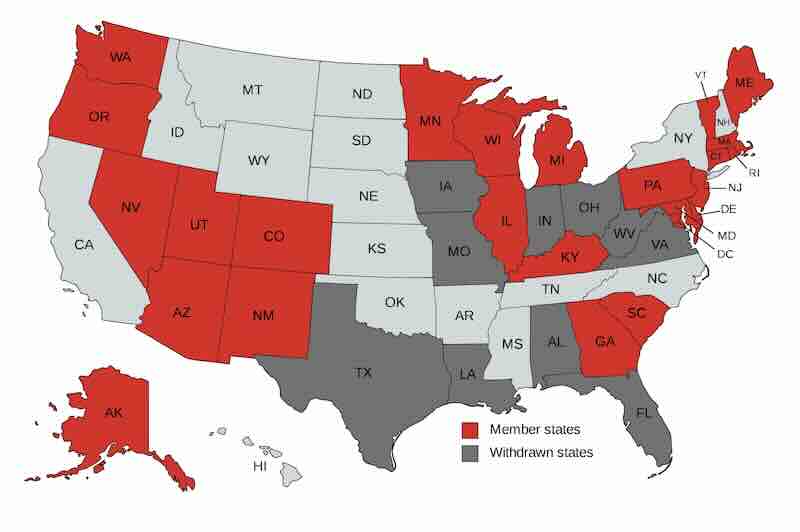
Electronic Registration Information Center is a nonprofit membership organization governed by participating states. ERIC aggregates limited voter registration and participation data submitted by those states then compares records across jurisdictions.
The goal is not enforcement, but identification. ERIC flags potential duplicate registrations, possible interstate movers and other anomalies that state election officials can then review under their own laws and procedures.
ERIC does not remove voters from the rolls. It does not prosecute election crimes. It does not run elections. Those decisions remain entirely with the states.
ERIC provides information that states otherwise do not have.
That distinction is often lost in public debate. Critics sometimes describe ERIC as a national database or a federalized system. It is neither. Participation is voluntary. Data usage is restricted by charter. Member states retain control over how information is evaluated and whether any action is taken.
More importantly, ERIC has produced tangible results.
In Washington and other states, ERIC data has identified individuals who voted in multiple states in the same election. Those findings were not theoretical. They were investigated by state authorities. In some cases, they resulted in referrals for prosecution and criminal charges.
Few other election integrity initiatives can point to comparable outcomes.
Despite frequent claims of widespread fraud, most investigations yield administrative errors or misunderstandings rather than prosecutable offenses. ERIC has been one of the few systems to generate evidence that withstands legal review.
That record raises an obvious question. If the goal is to identify double voting and improve voter roll accuracy, why target one of the only tools that has demonstrated an ability to do so?
Many critics argue that states should compare voter rolls across state lines and look for anomalies. That is precisely the function ERIC performs.
Others argue that a different organization should handle that task. That argument implicitly acknowledges the need for the function itself.
If the concern is trust in ERIC’s governance or structure, the appropriate response is reform or competition, not abandonment.
States and advocacy groups are free to create alternative nonprofit organizations with similar missions, transparent funding, and strict charters. They can propose improved methodologies and invite states to participate voluntarily.
Eliminating interstate data comparison altogether does not advance election integrity.
There is no existing government system that replaces ERIC’s role. No federal agency currently performs this analysis. Without ERIC, or a comparable organization, states revert to operating in isolation, unable to detect cross-state issues except by chance.
This debate highlights a broader problem in election policy discussions. Calls for clean voter rolls and strict enforcement are common. Support for the infrastructure required to achieve those goals is less so.
The Cascade Party supports accurate voter registration lists, enforcement of election law and state control of elections. We also recognize that cooperation between states is necessary in a mobile society and that voluntary, transparent data sharing is preferable to federal mandates or centralized control.
ERIC is not a political weapon. It is an administrative tool that provides information states can use to do their jobs more effectively.
Public confidence in elections depends on systems that are capable of detecting errors, identifying misconduct and correcting records lawfully. Removing one of the few mechanisms that performs that function does not strengthen election integrity. It weakens it.
If ERIC can be improved, it should be improved. If alternatives can be built, they should be. But until a replacement exists, abandoning interstate verification leaves states with fewer tools and voters with fewer assurances.
The Cascade Party calls on policymakers and election officials to evaluate election systems based on performance rather than suspicion. Serious problems require serious solutions. ERIC addresses a problem states cannot solve on their own, and that reality should guide the discussion going forward.
Damon Townsend is a former Pierce County Election Supervisor and has served as Interim Elections Manager in both Cowlitz and Clallam counties. He helped develop the VoteWA voter registration system and later served as the Washington Secretary of State’s Support and Training Manager for county elections offices statewide.