Cascade Party
A new path in Washington State politics.
A new path in Washington State politics.
Bi-State meeting punts on cost estimates.
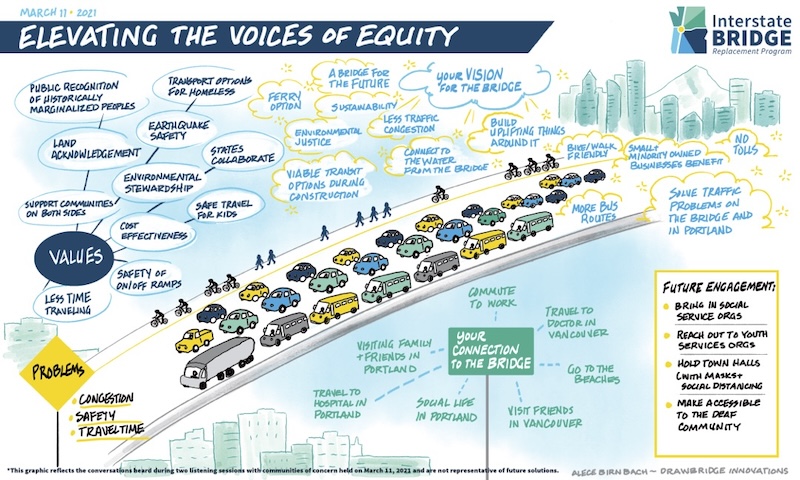
Interstate Bridge Replacement public relations material.
Cost estimates are waiting on approval for the river crossing part of the Vancouver / Portland I-5 mega-project. Estimates were due to be released today, however, the committee decided to wait until approvals. With costs rising, we need to discuss ways to scale the project to fit available funding.
By Johann Peters. (December 16, 2025)
The Interstate Bridge Replacement (IBR) is routinely described as a bridge. The bridge over the Columbia, connecting Vancouver, WA to Portland is only a piece of this proposed mega-project.
The IBR is approximately five miles of transportation function before and after the Columbia River.
The proposal attempts to be many things at once. It is not one bridge, but four bridge designs layered onto the same constrained corridor through I-5 in Vancouver and points south over Hayden Island.
Crossing the Columbia is the choke-point to a web of streets, boulevards, expressways and their interchanges. This is the current situation on both sides of the river.
None of these vehicle routes were designed as a single system. They evolved independently to serve ports, industry, aviation and other regional travel. The 5-mile IBR octopus attempts to force them into alignment.
By the time traffic arrives at the bridge location, it has already been funneled and sorted by the mega-project.
Under the project’s own earlier budgets, roughly 8 percent of the cost is the actual bridge over the Columbia River. About 30 percent is consumed by the elevated approaches. The remaining 62 percent is freeway reconstruction, interchanges and transit scope.
The expense is not the river crossing. The expense is the approximately five miles of approaches before and after the Columbia River.
Calling this a bridge project obscures where the money goes and why the price continues to rise.
Where are we going?
There is no settled design for the bridge itself at this moment. The project is waiting on the United States Coast Guard to sign off on any bridge crossing. This is due to maritime traffic passing through the Columbia River.
Building a span which clears ship height requirements will result in a grade too steep for transit rail.
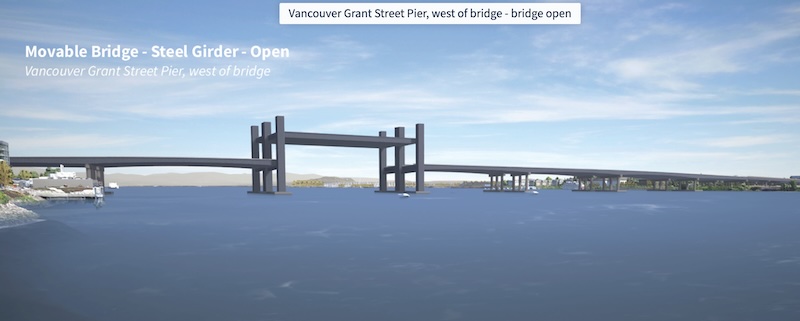
An option which solves this problem is a movable lift bridge — which also shortens approaches.
If realized, this will result in the only lift-bridge chokepoint on the entire I-5 corridor between Canada and Mexico.
Shrinking emissions.
Two decades of delay, redesign and indecision has required repeated environmental reviews, updated seismic standards, revised climate compliance and new engineering assumptions.
By the time the project is completed, vehicles, especially automobiles, will be overwhelmingly electric — a shift already driven by consumer market forces and governmental climate policy mandates.
Climate Change alarmists can rest easy, as local tailpipe emissions will fall whether the IBR exists or not.
This exposes the final contradiction.
A major environmental impact of the entire IBR will not be emissions resulting from vehicles getting people where they need to go.
Concrete, steel, earthmoving and years of construction disruption and detour routes will leave a permanent climate footprint long before the first electric vehicle crosses the new span.
Cost Punted
At a December 15th bi-state Washington–Oregon legislative meeting, the IBR program once again deferred cost clarity. Updated cost estimates were postponed until a later date, potentially sixty days after the United States Coast Guard determines final height clearance requirements.
This matters because clearance height directly drives approach length, rail grades and structural complexity.
Deferring cost until after that determination is not prudence, it is just another postponement.
Postponement has defined this project for more than two decades.
State Representative John Ley (LD18) says about the meeting, “The project, currently estimated at $7.5 billion with $2 billion dedicated to transit, is already behind schedule. With costs rising, we need to discuss ways to scale the project to fit available funding.”
We were supposed to get the new cost estimates this week, and now will have to wait until at least spring 2026 for the new price tag.
Again, then it’s a matter of what kind of bridge / crossing will be chosen.
Eyes on the Prize
And for all that scale and expense, the IBR offers little in return to the eye. It is infrastructure reduced to spreadsheets and traffic models, stripped of civic ambition.
The Gordie Howe International Bridge between Detroit and Windsor proves another path is possible. It shows that large infrastructure can be functional, efficient and visually magnificent at the same time. It treats a crossing as civic architecture, not just a traffic solution.
I can only wonder what the price tag for the 5-mile behemoth will be in the spring of 2035?
Indeed, we need to discuss ways to scale the project to fit available funding.
Johann Peters is on the Cascade board of directors serving in one of the postions for district 3/6.