Cascade Party
A new path in Washington State politics.
A new path in Washington State politics.
Clark County transit riders already transfer from buses to nearby light rail in Portland.
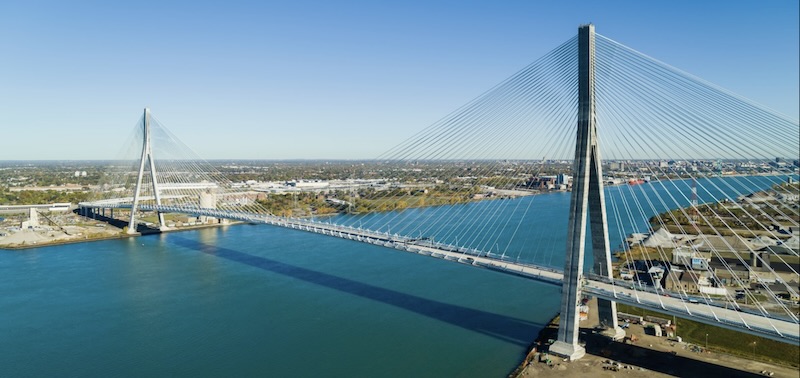
Detroit Windsor Gordie Howe Bridge is nearing completion.
There is still time to say no to extending Portland's MAX light rail through the Interstate Bridge Replacement (IBR) proposal for Vancouver. The whole project is on paper at this point. The current IBR director is leaving and new budget estimates are due this month. Clark County's C-TRAN bus system can still keep connections to nearby Portland light rail.
By Johann Peters. (December 10, 2025)
Driving over the frumpy, green steel span connecting Vancouver to Portland, it's easy to wonder why there is not a modern bridge? The frustrating truth is, for almost twenty years, the argument has not been about the bridge itself, but about extending Portland’s nearby MAX light rail into Vancouver.
Choosing not to include MAX does not mean building a single-commuter cars only bridge. A new span can accommodate C-TRAN buses, HOV lanes, ride share, bicycles and future technologies.
The rail component has been vexing the proposal all along. Rail is so expensive, even discussing it has cost tons of public money. We have already spent nearly half a billion dollars on general bridge design alone.
There was some momentum, which eventually fizzled into where we are today. Nevertheless, the scuttled Columbia River Crossing effort spent nearly $200 million — without building anything. The revived IBR has already exceeded $270 million in consulting and design.
A river-crossing bridge without rail was estimated in 2023 at $1 to 1.5 billion. A summary of the MAX Light Rail extension in the IBR estimates the light-rail portion adding a cost of $1.3 billion to $1.99 billion.
Current total project cost estimates for the whole IBR are $5.5 billion. A new estimate is due this month.
There are alternatives to rail. A managed-lane design that uses the existing C-TRAN system keeps the core bridge in the lower cost range.
Max Rail Adds Billions For Very Limited Use
Portland’s MAX averages around 62,000 weekday boardings in a region of more than 1.8 million people. This is under 4 percent of the population.
Clark County’s C-TRAN bus service averages about 15,000 weekday trips with a population of roughly 350,000, also under five percent.
Look north to Sound Transit for a similar story. According to Charles Prestrud, “In the Puget Sound region residents make a total of about fourteen million trips per day. That’s trips to and from work, school, shopping, etc. Of that total, light rail accounts for less than one percent.”
Prestrud notes how public transportation use is down in the Seattle area, “Not only is total transit ridership in the region lower today than it was in 2019, it is also lower than it was fifteen years ago!”
We Can Connect Without Importing Rail From Portland
Indeed, rail benefits the few lucky riders situated where it’s convenient to get to a station. For the majority of others, it requires a bus ride to reach a fancy train station.
Clark County transit riders are expected to make transfers to get to a light rail facility on the river's north side. C-TRAN busses already cross the I-205 Glenn Jackson bridge to link with Max stations on the south side of the river.
If you live in Vancouver near I-205, including all points to the north and east, the short bus ride to get to the MAX near PDX makes the most sense, rather than commuting west through town towards I-5. The Mt. Hood MAX station is off the first 205 exit into Oregon.
Camas Washington is east of I-205. Their city council unanimously passed a resolution opposing the IBR light rail component over concerns it would burden residents with high costs and little benefit.
Building Bridges
Gregory Johnson, the IBR program director, is stepping down after 5 years leading the project. He’s heading home to Michigan for personal reasons.
What matters at this moment is to find new leadership for a bridge replacement without rail.
Johnson was an early leader in building the magificent Gordie Howe Bridge between Detroit and Windsor, Canada. He recently said it was easier to get two countries to to agree on that bridge project than dealing with Washington and Oregon!
Of course building the new Detroit - Windsor bridge was easier to get started — its planning did not include light rail.
Johann Peters is on the Cascade board of directors serving in one of the postions for district 3/6.